
ASEAN countries are shaping a new approach which is demand-driven and regionally-owned to protect farmers and strengthen agricultural resilience through shared financial innovation.
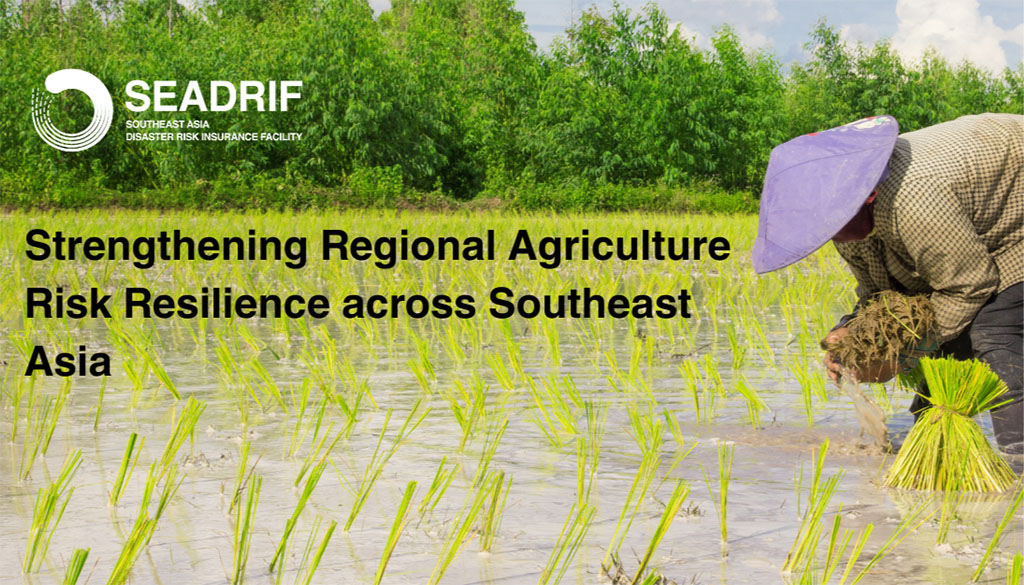
Across Southeast Asia, agriculture remains the heartbeat of rural life — a source of food, income, and identity for 91 million people, contributing 9.6% to the region’s economy. Rice, maize, cassava, and other staples sustain both households and national exports, yet every season carries rising uncertainty. Southeast Asia ranks among the world’s most disaster-prone regions, with data from the Food and Agriculture Organization of the United Nations (FAO) showing that Asia absorbed 40% (USD 1.72 trillion) of global agricultural losses between 1991 and 2021.
In response, ASEAN governments have stepped up efforts to build resilience. Countries have advanced national crop insurance programs, developed disaster risk financing frameworks, and integrated climate adaptation into agriculture policy. These initiatives have improved protection and awareness, yet progress remains uneven. Coverage gaps persist, data and technical expertise are limited, and the cost of reinsurance remains high. Most farmers continue to rely on public relief or personal savings to recover from shocks — responses that are neither timely nor sustainable. The result is a widening protection gap that threatens livelihoods, fiscal stability, and regional food systems.
It is within this landscape that SEADRIF-RAISE — the Regional Agricultural Insurance & Sustainable Economies Facility — is taking shape. The initiative is part of a broader collaboration between the Southeast Asia Disaster Risk Insurance Facility (SEADRIF) and the FAO, supported by the Green Climate Fund (GCF) under a 2022 ASEAN Agriculture Sector Readiness Grant. The Readiness program aims to strengthen climate-resilient agriculture across ASEAN by developing new GCF project proposals, including the design of a regional agriculture risk finance mechanism as one of its key outputs. At the request of six ASEAN member countries—Cambodia, Lao PDR, Malaysia, the Philippines, Thailand, and Viet Nam—SEADRIF and FAO are working to develop a regional mechanism to strengthen financial resilience of small holder farmers and the agricultural sector. With technical inputs from Howden insurance advisors, SEADRIF, in collaboration with FAO and the six countries, is finalizing the technical work to determine the most suitable structure for this facility and to inform the funding proposal to the GCF. Building on this, SEADRIF-RAISE is envisioned as a concrete platform that turns readiness into action by providing countries with practical access to risk financing, technical support, and resilience-linked investment opportunities.
Where SEADRIF-RAISE fits, and why now
SEADRIF-RAISE is being shaped to meet this moment: demand-driven and regionally owned, aligned with ASEAN guidance and country priorities. It aims to help ASEAN countries secure predictable, affordable insurance protection for their agricultural sectors while pooling risks regionally to lower costs, strengthen domestic markets, and bring in more global private sector capital for protecting farmers against shocks.
Developing SEADRIF-RAISE as a core program under SEADRIF is deepening the use of insurance to ensure resilience, rooted in shared priorities, built through evidence and dialogue, and grounded in the everyday realities of farmers across Southeast Asia. It’s about transforming how the region prepares for and recovers from agricultural shocks, turning ad-hoc crisis response into pre-arranged financial resilience.
In short, SEADRIF-RAISE is designed to make climate-smart protection work for people — the rice farmer in Quảng Ninh replanting after floodwaters recede, the cassava grower in Isaan hedging against a late monsoon, the maize producer in Mindanao riding out a typhoon season — while strengthening fiscal resilience for governments and stability for markets. It’s a collective vision for a safer, stronger agricultural future — one where Southeast Asia’s farmers can plant with confidence, recover with dignity, and grow together toward lasting resilience.