
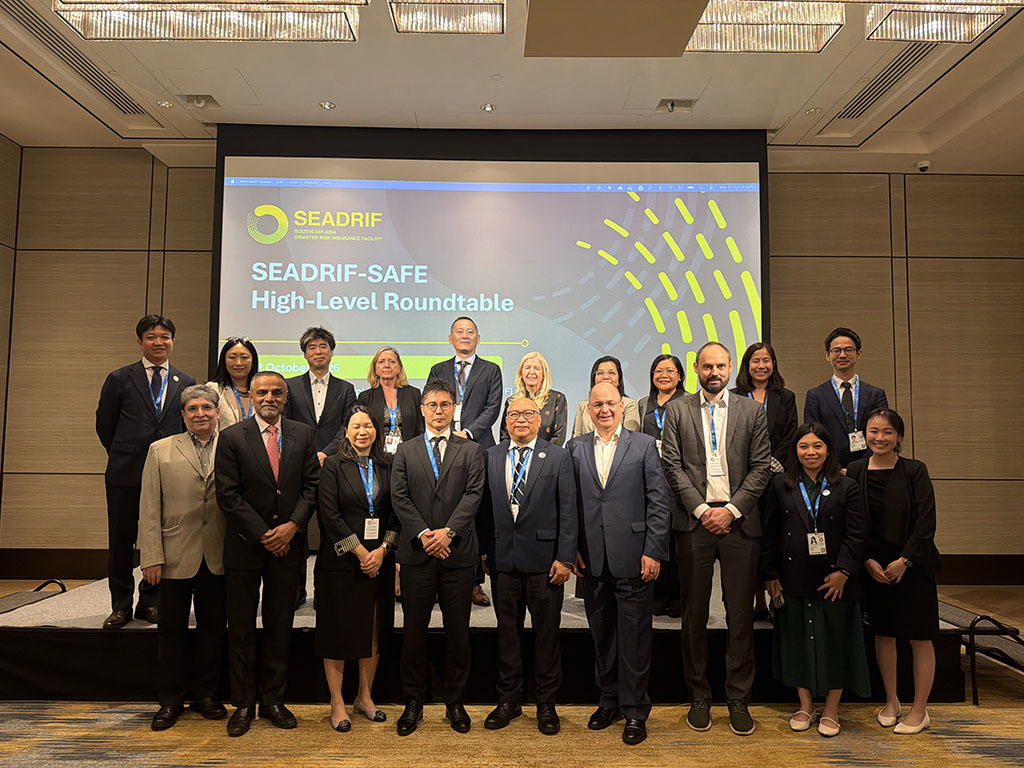
Yesterday, on the margins of the World Bank/IMF Annual Meetings in Bangkok, Thailand, representatives of ASEAN+3 economies and development partners met to discuss the development of the SEADRIF Sovereign Assets and Fiscal Empowerment Facility (SAFE), a proposed regional facility to protect public infrastructure and critical public services against disaster and climate shocks.
Against a backdrop of growing disaster risk globally, SAFE has the potential to lead to a paradigm shift in resilience, with risk engineering and multi-year insurance treated as an investment rather than a cost in new public asset development.
Preserving the Development Promise of Public Infrastructure
Countries build roads, bridges, dams, power plants, hospitals and schools for the livelihoods they enable and economic opportunities they provide. It is these assets that connect people to jobs and markets, keep homes and businesses running, support trade, and create conditions for growth over decades.
But this infrastructure is also highly exposed to natural hazards. Across Southeast Asia, severe flooding is already showing how quickly this generational promise can be put at risk. For example, in Tarlac, Philippines, heavy southwest monsoon rains and strong currents in the Tarlac River damaged two bridges in late August, disrupting the road links on which communities, services and local economies depend.
This challenge was dramatically brought to the world stage in Nepal, where a tragic flash flood in August brought the fragility of public investment into sharp focus. The scale of the crisis was overwhelming, with more than 1,400 people reported killed and more than 5,000 still missing.
At the United Nations General Assembly, Nepal's Prime Minister Balendra Shah noted the disproportionate impact of such tragic events on his nation’s progress.
“Climate Justice cannot just remain a beautiful phrase in a United Nations Document,” he said. Nepalis must be “allowed to build their future instead of constantly rebuilding their past.”
Severe damage to both operational and under-construction hydropower projects showed how decades worth of investment can be lost in an instant. And barely a month later, in October, a further flash flood washed away houses and bridges and damaged another hydropower project along a river in central Nepal.
These events are becoming more frequent and each one demonstrates why infrastructure resilience matters. When public assets fail, the effects extend beyond the site of the damage: essential services are disrupted, livelihoods are affected, recovery costs rise and development gains are set back.
From flooding and extensive rainfall to severe heat and drought, events affecting Southeast Asia reinforces this regional imperative. Governments are investing heavily in developing new infrastructure that will shape their regions for decades. But without also investing in the resilience of these assets, development gains can be short-lived.
SEADRIF-SAFE is being developed in response to this challenge: a regional facility to reduce infrastructure losses through improved risk engineering, and provide cost-effective financial protection to avoid prolonged disruption to the services and economic opportunities that public assets provide, ultimately to ensure development gains are safeguarded for future generations.
Infrastructure as a Foundation for Growth
The pattern of insurance claims emerging from Nepal also illustrate the financial protection gap that can affect the pace and cost of recovery.
By 28 September, claims reported from the Nepal Insurance Authority records totalled NPR 20.98 billion (about US$139 million), around 5% of the NPR 408.29 billion (US$2.70 billion) in total disaster effects estimated by the Rapid Damage and Needs Assessment conducted jointly by the National Disaster Risk Reduction and Management Authority (NDRRMA) and the National Planning Commission.
While only a small proportion of losses were insured, initial estimates also indicated that about 80% of insurance claims were concentrated on assets under construction, highlighting the extent of the protection gap for operational assets.
This reflects the fact that large infrastructure projects are commonly insured during construction because lenders and public procurement rules require it, but this insurance ceases at project completion. Public assets then become uninsured at the moment when their value is the highest and when they start to deliver value through providing essential services and supporting economic activity.
For governments in Nepal, Southeast Asia and elsewhere, the consequences of losing an inadequately insured public asset can be significant. Rebuilding can place additional pressure on public budgets, delaying other investments and slowing recovery.
A country can end up using tomorrow’s resources to replace what it built yesterday.
Closing Protection Gaps in Data-Poor Environments
Nepal’s experience shows how innovative insurance can help address protection gaps where disaster risk is significant but conventional insurance capacity is limited.
Following the 2015 Gorkha earthquake, the Upper Trishuli-1 hydropower project struggled to secure earthquake coverage during construction.
A five-year parametric insurance policy developed by Swiss Re helped bridge that gap. Designed specifically for earthquake risk during construction, the cover provided lenders with greater confidence to proceed despite limited traditional underwriting options.
The case is a useful example of how early attention to disaster risk, combined with fit-for-purpose insurance solutions, can help keep critical infrastructure investment moving in data-poor environments.
While the policy itself focused on the construction phase, it raises a wider question for Southeast Asia: how can similar approaches be extended across the infrastructure lifecycle, so that assets remain financially resilient not only while they are being built, but also once they begin delivering essential public services and economic benefits?
Protecting ASEAN's Development Promise
ASEAN requires more than US$200 billion in infrastructure investment every year to sustain growth, reduce poverty and response to climate change, while estimated average annual disaster losses to infrastructure assets are around US$12 billion. SAFE is designed to build protection into public infrastructure from the outset.
It aims to bring insurers’ and reinsurers’ risk-engineering expertise into project design, helping to strengthen standards and loss-prevention measures before assets are built. SAFE then foresees multi-year insurance cover as assets become operational, extending financial protection beyond the construction phase. This helps ensure that, following a disaster, funding is available to repair or rebuild critical public assets and maintain the economic outcomes they were intended to deliver.
Embedding insurance premiums directly in development-partner-financed projects can make this protection more affordable and reliable. It can avoid the uncertainty of annual budget appropriations and, on a present-value basis, could deliver premium savings of more than 10 per cent.
By aggregating projects across ASEAN through a regional facility, SAFE can pool risks across countries and sectors, diversify exposure and secure better access to insurance and reinsurance markets. Analysis shows that this joint, regional approach has the potential to reduce premiums by more than 25 per cent compared with standalone arrangements.
With protection and financing arranged in advance, governments can recover sooner after a disaster, reduce pressure on public budgets and preserve resources for future development. SAFE proposes an approach that treats insurance not as a cost after the fact, but as an investment in protecting ASEAN’s development promise.
Much of the infrastructure the next generation will depend on is being financed and built today.
The challenge is to ensure that when disaster strikes, Southeast Asia's economies can recover without sacrificing the next generation of investment to rebuild the last.