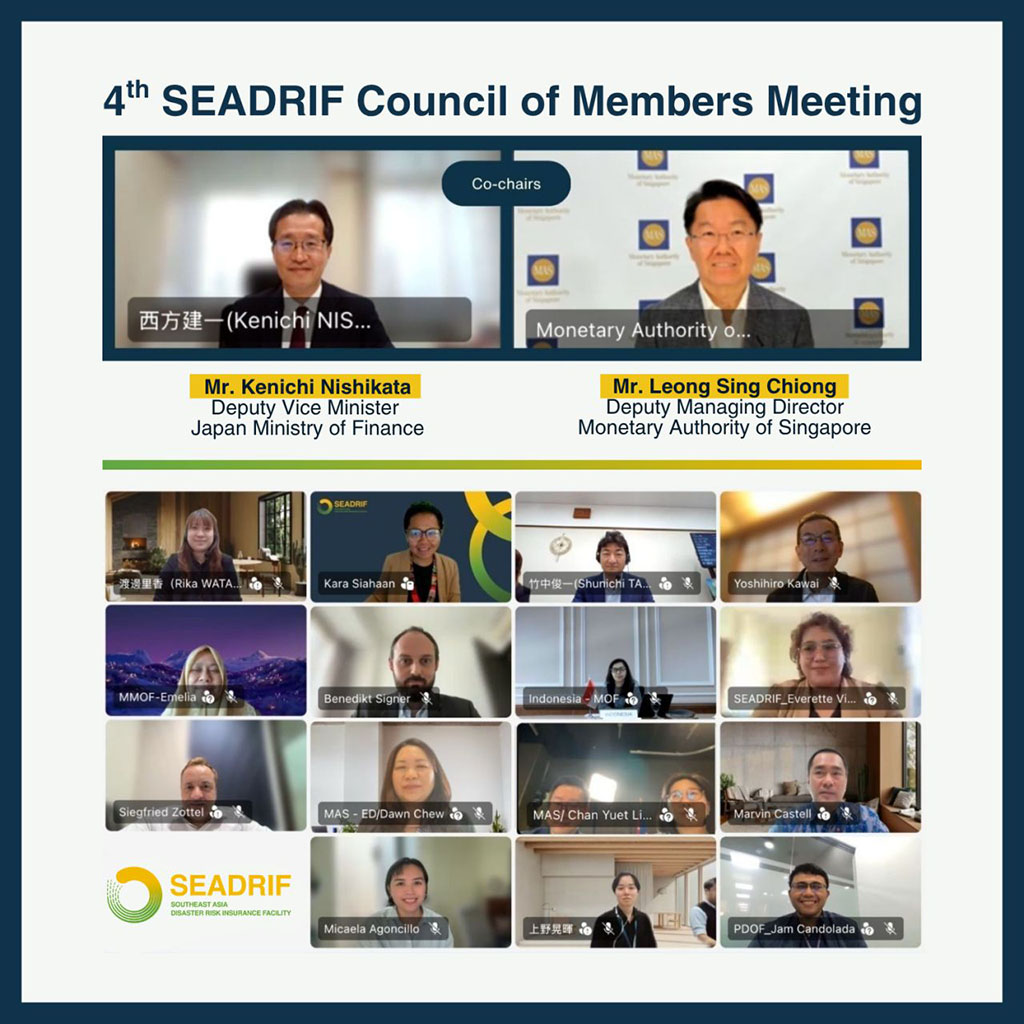
SEADRIF convened its 4th Council of Members Meeting on 21 April 2026, where member countries agreed on key outcomes to advance regional cooperation on disaster risk financing.
Co-chaired by the Governments of Japan and Singapore, the meeting included representatives from Cambodia, Indonesia, Lao PDR, Myanmar and the Philippines. It was also attended by observing representatives from Malaysia, Thailand, the ASEAN Secretariat, CSC Global as SEADRIF Trustee, and the World Bank as Lead Technical Partner.
The virtual meeting follows the ASEAN+3 Finance and Central Bank Deputies Meeting (AFCDM+3) held on 8 April 2026 where deputies endorsed the ASEAN+3 Disaster Risk Financing Initiative (DRFI) Roadmap 2026–2028.
The Council of Members Meeting discussions connect to broader efforts under the ASEAN+3 framework to advance a regional disaster risk financing agenda, including the development of the DRFI Roadmap 2026-2028.
It brings together senior representatives from member finance ministries to guide SEADRIF’s strategic direction. At a time when climate and disaster risks are placing growing pressure on public finances across the region, the 4th meeting marked an important moment in shaping how countries strengthen financial protection.
Key outcomes include:
1. SEADRIF 2030 Strategy
The meeting advanced and endorsed key elements of the SEADRIF 2030 Strategy, which will set out the facility’s long-term direction.
Building on earlier technical work, the Strategy will clarify SEADRIF’s core focus, institutional arrangements, and commitments. These elements will shape how SEADRIF supports financial resilience across Southeast Asia for the next five years, with the full Strategy to be formally approved in May.
2. Insurance as core and primary function
The Council confirmed SEADRIF’s delivery-focused approach anchored in insurance, recognizing that pre-arranged, market-based instruments are among the most effective tools for governments to manage disaster-related fiscal shocks.
This focus will enable SEADRIF to deliver timely liquidity after disasters while supporting fiscal stability. At the same time, there is scope to expand into complementary disaster risk financing programmes where demand is clear and capacity allows—ensuring growth remains practical and responsive.
3. Institutional alignment
The Council discussed closer alignment between the SEADRIF Initiative and the Insurance Company by integrating member engagement and governance functions within the Company, bringing strategy and implementation more closely together as SEADRIF scales its operations with modalities to be designed following legal and regulatory review.
As SEADRIF grows, this shift will help reduce fragmentation and make it easier to move from design to delivery, while maintaining accountability to members.
The key outcomes that emerged from the meeting point to growing momentum from alignment toward implementation. As disaster risks intensify and fiscal pressures grow, SEADRIF will continue to focus on delivering solutions at scale.
In addition to key outcomes, the Council acknowledged key progress and achievements made in regional disaster risk financing since the 3rd Council of Members meeting.
These included SEADRIF’s payout of US$6.5 Million to Lao PDR since the first policy in 2021, and its planned expansion to four active policies in 2026.
The Council noted SEADRIF’s transaction advisory support for enhancing a parametric agriculture insurance placement for cooperatives in the Philippines and the development of regional initiatives such as the Sovereign Assets and Fiscal Empowerment Facility (SEADRIF-SAFE) and the Regional Agricultural Insurance & Sustainable Economies Facility (SEADRIF-RAISE).
The Council also noted the need to mobilize additional capital and explore a broader range of funding sources to support a growing pipeline of country engagements and insurance solutions.
SEADRIF plays an important role in supporting the implementation of disaster risk financing across Southeast Asia, translating regional priorities into practical financial solutions and country-level support. The continued evolution as a regional, member-driven platform positions it to play an increasingly important role in strengthening financial resilience across Southeast Asia.
Sustained political commitment, stronger financing, and close collaboration will be key to translating these priorities into tangible impact across the region.
About SEADRIF: Taking the Crisis Out of Disasters
SEADRIF is a regional platform established and owned by ASEAN+3 countries to strengthen disaster and climate resilience through pre-arranged financial protection and advisory support. It provides access to rapid and predictable funding when shocks occur, enabling governments to better manage disaster-related costs.
Through its regulated insurance company set up in Singapore, SEADRIF blends public and private capital to expand access to new forms of development insurance. Working closely with member countries, it co-designs solutions that are fit for purpose and scales them across sectors, geographies, and perils—helping protect people, economies, and futures across Southeast Asia.
Follow SEADRIF on LinkedIn. For inquiries, please email: contact@seadrifinsurance.com