Disasters cost Southeast Asia an estimated USD 86.5 billion a year. In recent years, close to 90 per cent of disaster losses in Asia and the Pacific have been uninsured. Governments absorb the shock, and recovery is slower and costlier than it needs to be.
SEADRIF is ASEAN's development insurer. Established by ASEAN+3 countries and owned by its member governments, it is a private regulated general insurance company in structure, an ASEAN+3 government mutual in business model and a development institution in purpose. It stands between its members and global reinsurance markets, as multilateral development banks do with capital markets. It co-designs protection with governments, pools risk across countries and perils, and places it with international reinsurers, so funds are in place before disasters strike. It has paid out close to USD 9 million within days of reported disasters and mobilised more than USD 230 million in private reinsurance capacity.
The model is proven. The task now is scale. Member governments set direction through the Council of Members. The SEADRIF Insurance Company, the Singapore-regulated insurer they own, delivers it. The two strategies are complementary: one sets the political direction, the other drives delivery.
SEADRIF 2030 Strategy
Adopted by the Council of Members, the 2030 Strategy sets SEADRIF's direction towards its vision of an ASEAN region resilient to climate and disaster shocks. It marks the shift from pilots to systems, and from one-off transactions to protection that renews year after year.
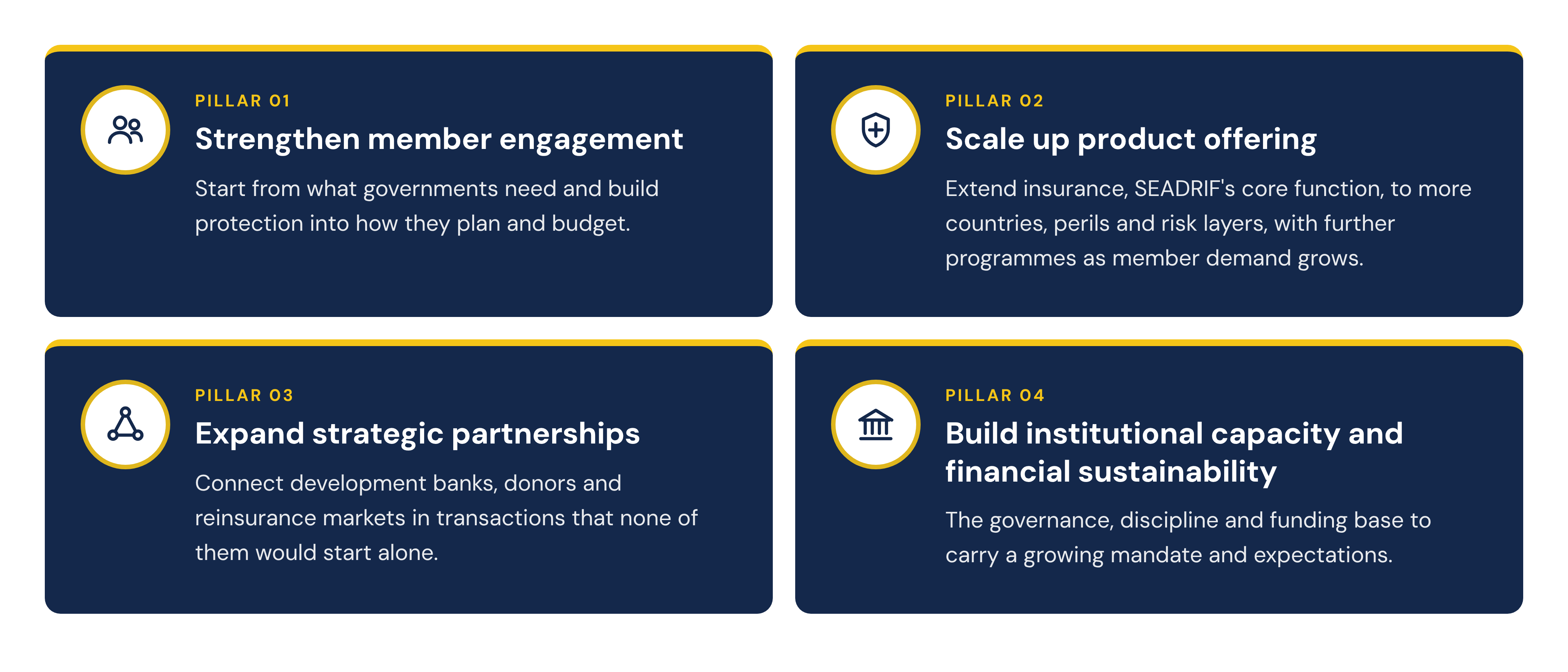
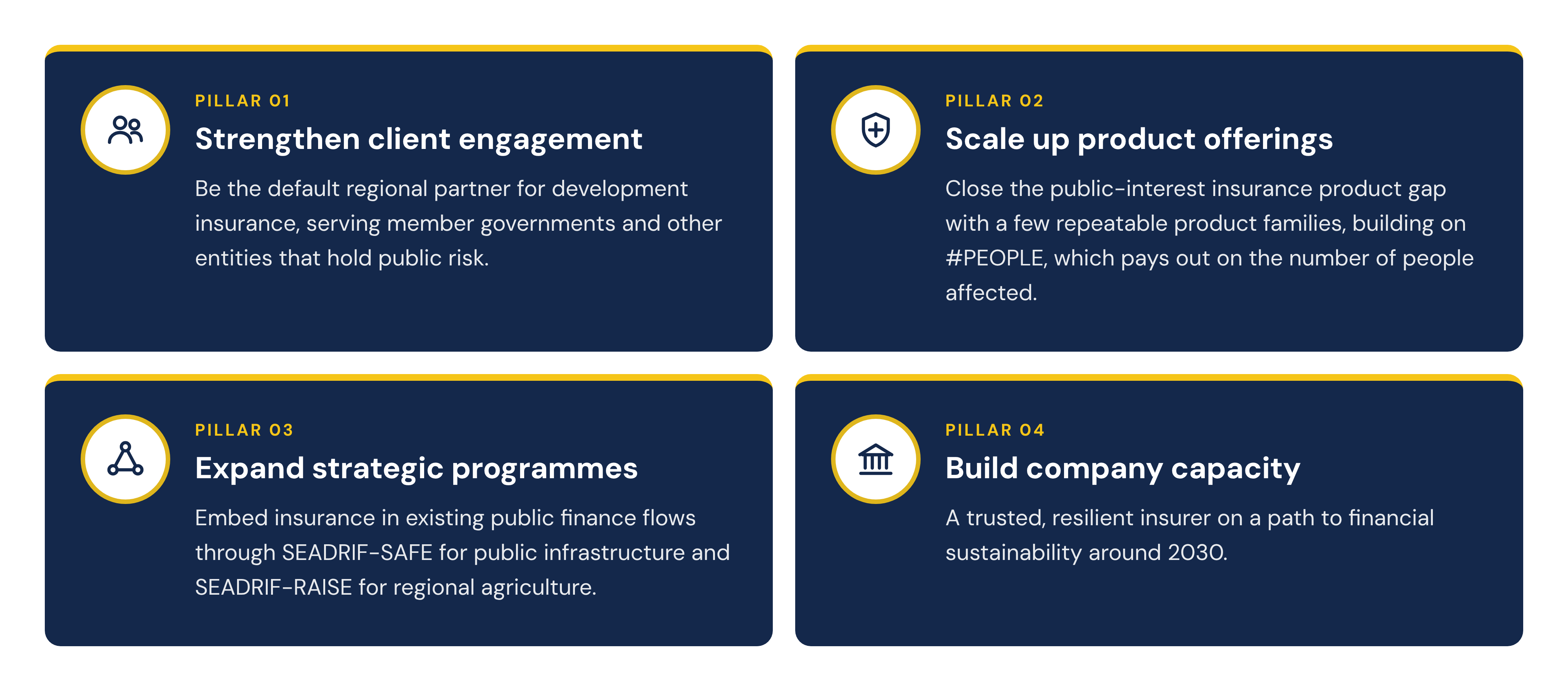
The Strategy organises SEADRIF's work to 2030 around four pillars that reinforce each other: engagement with members creates demand, institutional strength makes scale credible, and partnerships extend reach.
SEADRIF SEADRIF Insurance Company Strategy 2026-2028
The Company Strategy sets out how SEADRIF Insurance Company moves from proof of concept to scale. By 2028, SEADRIF aims to be the default regional platform for public risk in ASEAN: the first call for governments and public institutions seeking disaster risk financing.
As a non-commercial, member-owned insurer, it uses limited concessional capital to take on risk that markets cannot price affordably for public buyers, so each dollar of public capital mobilises multiple dollars of private reinsurance capacity. By retaining the first and most expensive layers of risk itself, SEADRIF can push the boundaries of what markets will write for public risk, into new products, perils and data-scarce markets, and build the track record that makes broader participation possible.
Four pillars translate the 2030 direction into the Company's priorities, each with an objective to reach by 2028.
SEADRIF is one part of a wider effort in which development banks, development partners and reinsurance markets each play a role. We invite partners to read the strategies and work with us to contribute to an ASEAN region resilient to climate and disaster shocks.